


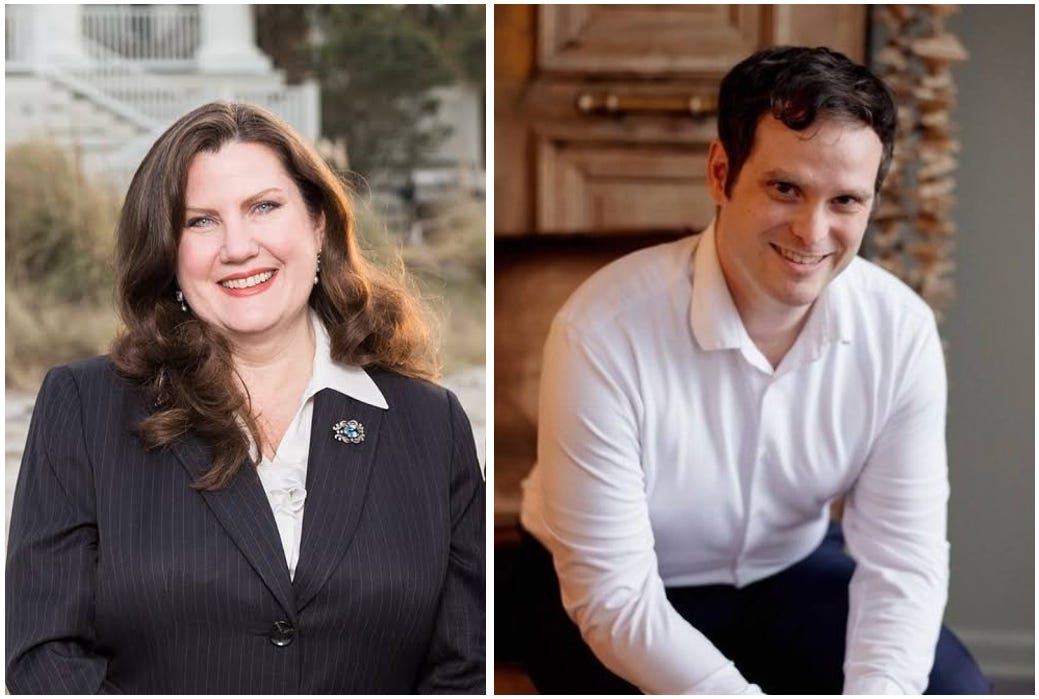
Seth Zeren talks with Will McCollum (architect, urbanist, and founder of Citymakers Collective) and Christine Franck (architect, educator, and author; first executive director of the Institute of Classical Architecture & Art) about what it means to be a "city builder," the gaps in professional design education, and the story behind Citymakers Collective's Summer Studio — the urban-design intensive Will and Christine built together, in partnership with INTBAU USA.
Organizations & Programs Mentioned
Citymakers Collective — citymakerscollective.org — Will’s organization; runs the two-week Summer Studio
Clever Communities Workshop — citymakerscollective.org/clever-communities-workshop — New economic-development workshop, Dallas area, September
INTBAU (International Network for Traditional Building, Architecture & Urbanism) — intbau.org — Global network; celebrated 25th anniversary in London
INTBAU USA — intbauusa.org — US chapter; co-organizes the Summer Studio with Citymakers Collective
Institute of Classical Architecture & Art (ICAA) — classicist.org — Christine’s former organization; runs its own summer program since 1992
Congress for the New Urbanism (CNU) — cnu.org — Referenced throughout as a hub for New Urbanist practice
(New) Urban Guild — urbanguild.org — Christine is a founding member
The King’s Foundation (formerly the Prince of Wales’s Institute of Architecture / The Prince’s Foundation) — kings-foundation.org — Ran the first traditional-architecture summer school in 1990
University of Colorado Denver, College of Architecture & Planning — architectureandplanning.ucdenver.edu — Christine established a research center here
Georgia Tech School of Architecture — arch.gatech.edu — Will and Christine both taught/studied here
Tulane School of Architecture — architecture.tulane.edu — Will’s graduate program (real estate development + M.Arch)
University of Notre Dame School of Architecture — architecture.nd.edu — Referenced as a model of a distinctive, non-mainstream program
Lew Oliver / Whole Town Solutions — wholetownsolutions.com — Will’s early mentor in New Urbanism
Books Recommended
How Buildings Learn: What Happens After They’re Built — Stewart Brand (Christine’s pick) — Penguin Random House
Against the Machine: On the Unmaking of Humanity — Paul Kingsnorth (Christine, currently reading) — Penguin Random House
The Image of the City — Kevin Lynch (Will’s pick) — MIT Press
The Art of Building Cities — Camillo Sitte (Will’s pick) — overview; currently in print via Martino Fine Books, among other reprint editions
Architectural Principles in the Age of Historicism — Robert Jan van Pelt & Carroll William Westfall (Christine’s pick) — Yale University Press, via Goodreads
Also Referenced
Windsor Forum on Design Education: Toward an Ideal Curriculum to Reform Architectural Education (New Urban Press, 2004) — proceedings of an April 2002 gathering of architecture educators in Windsor, FL, including Christine’s own contribution. Christine’s write-up · CNU book review
The Boyer Report (Building Community: A New Future for Architecture Education and Practice, 1996) — mentioned in connection with the Windsor Forum as a landmark study on design education
The New School for City Builders — Will McCollum & Christine Franck
Seth: Hello and welcome to The New School for City Builders. I’m your host, Seth Zeren, a recovering city planner turned neighborhood developer in Providence, Rhode Island. This is a podcast about how we can transform the education of city builders. If we want to change how our cities and towns work, we need to change the people who run them. We need a new generation of city builders — architects, engineers, planners, developers, city managers, and civic leaders. We need a new school for city builders. Joining me today are Will McCollum and Christine Franck.
Will is an architect and urbanist based in Boston and the founder and driving force behind the City Makers Collective and its summer studio, which just wrapped up its second summer a few weeks ago. We heard about the summer studio from Sarah Biga and Jack Duncan in episode two, and we’re excited to get a behind-the-scenes look at how that got created. Christine Franck is an architect, educator, and author living in Denver, Colorado, and was instrumental in helping launch the summer school. Christine has a long history as an educator and leader in classical and traditional architecture and urbanism, including serving as the first executive director of the Institute of Classical Architecture and Art, which also runs its own great summer school; as a founding member of the Urban Guild; and as a founding member and chair of the USA chapter of the International Network for Traditional Building, Architecture and Urbanism — better known as INTBAU.
Will, Christine, welcome to The New School for City Builders.
Christine: Thanks for having us, Seth. It’s nice to be back together with Will — we just spent two weeks in Charleston, as you know, so this feels a little like a reunion.
Will: Yeah, it’s lovely to be here. Thanks.
Seth: It’s a nice place to get to spend a couple weeks with friends looking at cities and buildings. So let’s start with both of you: I use the term “city builder” a lot — it’s the name of the podcast — and I’m curious what that means to each of you. Christine, why don’t we start with you?
Christine: Sure. A city builder — city building, I think in a way, Seth, strikes me as distinct from placemaking. Placemaking’s good, but city building — and I’m familiar with your work and some of your ideas — I think is ultimately not merely about the mechanisms that are in place that create our cities, but that we’re actually creating the cities themselves: the civitas, the community of people who live in a place, who make a place theirs, who own their place. So it’s about the making of the city, not as a physical place, but as an entity within people’s communities. That’s what I think of as city building, and it’s what I hope I’ve always contributed to in my career as an architect and educator.
Seth: I love that — the city is not just some buildings, it’s also the people who live within it.
To be a city builder, I see it as — there are these city-building professions, right, that become these professional silos: architecture, planning, engineering, development. But to bring those together, and to think about them not just as building a physical place that we call the city, but also the broader community, the institutions, the business models, how you actually run this place... I feel like when I encounter students who see this larger vision, but then they go through professional education, they feel like they’re getting some partial, very thin experience. So, Christine, from your perspective, what does a young person need to learn in order to become a great city builder?
Christine: I think, Seth, in many ways, one of the most important things a young person can do is actually just get involved with their community. I think we go through education, and so much of our university educations today are skills-based — it’s as if you’re going to university to get a degree in order to get a job. And I think that loses the idea of what a university education is meant to be, which is a very broad education. You might have a little bit of philosophy, a little bit of history, you might begin to think about what you want to specialize in. I really encourage students that I mentor to take a very broad career path and degree at the undergraduate level, and then, if they need to for professional certification — like becoming an architect — to specialize in a master’s program where they can make a very conscious choice.
But I think this idea — and I know you’re concerned about this too — of the siloing of the professions... really getting involved with your community at whatever level that is. Will and I may share a story about one of our students on the summer program who is just recently out of high school and has created a group and is advocating for change in his city.
I think the other thing I find with education is that students often come to me or to colleagues saying, “What do I need to learn? How do I do this?” And the fact of the matter is, people like myself, who got interested in these ideas thirty, forty years ago — we taught ourselves. No one is coming to rescue you. You kind of have to pick up, as Will has done with his colleagues at City Makers, as we did with INTBAU, as we once did with the Institute — you just have to pick up and do what you think needs doing. I’ll stop there.
Seth: I think one of the things I’ve observed too is that in some sense people still feel like they need permission — they need the credential to work. And one of the things I’ve noticed when I’ve traveled and worked internationally is that that hasn’t been true in all places and all times. It used to be the case that many people would just do stuff, and it might be a very small scale — it might just be building something on their street: a wall, a shrine, a well, a market. It was just at this very incremental level, and it didn’t need to have imprimatur and all this history. That’s the meaning of vernacular urbanism, vernacular design and creation.
So, for you, Will — what does it mean to be a great city builder, and what does a young person need to be learning if they want to walk this path?
Will: I think a great city builder is active in their community. Like Christine was just saying, they take an active role in the creation of their own place. When we formed City Makers Collective, with “City Maker” similar to “City Builder,” we were really intentional with that phrase because we wanted to be inclusive of all of the people who touch the built environment. I think a lot of times in discussions about cities we’re focused on urban planners, architects, developers — but there are community advocates out there who sometimes do better work than the professionals, people who own storefronts who contribute more to the civic environment than many others in the city. So I think being a good city maker is just being somebody who is trying to engage with that civic space, with community, and figuring out their specific way to plug in and make their place, their home, a little bit better.
Seth: Reflecting on what you both said, I think one challenge we have in the way we structure higher education that prepares people for these professional roles is that most schools assume you’re getting a generic education — the engineering degree you get in the Southeast is going to be similar to the one you get on the West Coast, similar to New England. And part of that dynamic is that we actually denature it from the place that you’re in. We strip out the opportunities to be grounded in the specific place, institutions, and economy your school is in, because you want to make it maximally mobile and interchangeable with other institutions. And I think the way we’ve done that means that in the undergraduate curriculum, you’re often fighting the institution to really get your feet in the ground in the place you’re in. There’s obviously some variance — people are doing more project courses — but the curriculum still isn’t going to be, say, “Charleston architecture” in Charleston.
Christine: Just so I’m not misunderstood, I will say, Seth, I disagree with you, based on my experience teaching at universities and encountering a lot of different students along the way. I don’t agree with the idea that universities are providing an education that’s meant to be nationwide, and that they’re not engaging with their communities in project-based, locally-based design studios. I disagree.
Seth: Certainly, I think you’re right in the design studios — I see that a lot, that’s true. But what I’ve noticed, at least in the curricular offerings, is that I haven’t seen that dynamic play out as much. The urban theory is very similar in different schools; the engineering program curriculum is nationally standardized. So there are trade-offs between the project-based work, which does tend to use local projects, and the theoretical components, which I think tend to be more broadly shared. Do you think that’s true?
Christine: No — but Will knows I can be a bit contrary at times. I’ve taught in some of our classical programs, like the University of Notre Dame; I’ve taught with what was the Prince of Wales’s Institute of Architecture, now the King’s Foundation; INTBAU; Georgia Tech; University of Colorado Denver, where I established a research center in their College of Architecture and Planning. I can’t comment on civil engineering or engineering programs, but when it comes to architectural education, planning, and urban design, my experience has been that while there are certain national standards being met by accredited programs, the programs are very much calibrated to their place, their traditions, the problems of that place — whether through the design studio or the engagement of local professionals in teaching professional practice classes. They’re very much geared to their place and locale.
Seth: That’s interesting. How would you contrast your experience in Colorado versus Georgia Tech between those two programs? In what ways were they similar or different?
Christine: So Georgia Tech — I was the Harrison Design Scholar, which was a program within the School of Architecture, though I may be getting the exact name of the program a little wrong. I taught a studio, co-taught it with Betty Dowling, and delivered various lectures. Will, I think, missed me by a couple of years. My experience at Georgia Tech — and I think of Georgia Tech as a fairly mainstream architectural program, distinct from highly specialized programs like Notre Dame’s program in classical architecture — was that our studio existed a little bit outside of the common studio culture, and I think that’s what drew students to it. In the course of our studio, we worked on understanding regional building traditions, particularly for residential architecture — and by architecture I’m always including urbanism in that description. The students then designed a project for an actual location and place near them; they had a choice of what they did.
Contrasting that to Colorado — I actually find that the University of Colorado, which again I’d call a mainstream and sound program, was far more place-based than at Georgia Tech, and that may just be because we’re so far away from everyone. We can’t easily hop on a train and go do a studio in New York City. But here we deal with very critical issues like water and water rights and wildfire — our natural resources feel much more present in mind than I ever found on the East Coast. Anyway — long answer there.
Seth: No, that’s interesting, and there certainly are important regional distinctions — that’s a helpful framework to think about them. So, Will, you and I have talked about how you came up in your educational experience. I was hoping you could walk people through how you got to where you are now — how did your schooling shape the evolution of your practice?
Will: Well, I’m not disagreeing with Christine, but I’ll provide a counterpoint. My journey was pretty curvy and all over the place. I joined Georgia Tech as an undergrad and studied there for four years. I studied abroad twice — one of those was in Hong Kong, at the Chinese University of Hong Kong, for a semester doing studio design. Then I worked with Lou Oliver, who’s very deep in the New Urbanism world, and that was my real introduction to urbanism and urban design. I went back to school after a few years — at Tulane University — to study real estate development and get my master’s in architecture, and then went back with Lou until last year. That’s the high-level overview of my trajectory.
But having studied at three different institutions — two of them in the South in the United States, and one on the other side of the world — I’ll say there wasn’t much difference in the way architecture was taught in Hong Kong versus Georgia Tech. I think Tulane was more place-based — it’s similar to Colorado in that it’s a very unique environment. You have the river, and New Orleans itself is really the only big city within 500 miles, so it’s a unique place and they really leaned into that. But the theory behind the design of what they were teaching was consistent across all three universities, and the approach with which they approached place was also the same. Even where some of them had a bigger focus on place, it was often an outside-looking-in approach — let’s analyze this place and pick out the things we like and lean into that — which is subtly different from “let’s learn the traditions of this place and expand those traditions.” And I think that was something I had to unlearn over the years and lean into a little bit more.
Christine: I agree with you there, Will. I think that’s a big distinction between what I’d classify as mainstream — I’m speaking primarily from a school-of-architecture perspective — mainstream programs versus some of these more unique programs that have developed over the last thirty years or so.
Seth: Will, with the hindsight of how your career has evolved, if you could go back and change something about the programs you went through, what would you want to change to make them better for you?
Will: It’s interesting — I was always drawn to urban design. For some reason I was set on being an architect, but I was always fascinated by urban design. I actually had a class at Georgia Tech — an exploratory class outside the architecture program, where they let you create your own major within the university. Part of that was developing your own curriculum, and the one I put together for myself was a combination of urban design, economics, architecture, and development — all the things I’m interested in and pursuing now as an urbanist and designer, beyond just the scope of a building. I had one class in my six years of education on urban design. I wish I’d been at Georgia Tech when Christine was teaching, because just hearing a professor say “there is no urban design without architecture” — that was never said. You never really looked beyond the scope of your building in my design studios, in terms of — maybe what materials are they using next door, maybe you’d look at the datum line of where the windows are and use that as a base — but beyond that it was never really a consideration.
And I think that’s what I would change: knowing the context you’re operating in, understanding how to actually analyze that and understand the patterns you see, and learning from that — either taking that pattern and continuing it, or evolving it, or sitting in contrast with it, and understanding when you make each of those decisions and why. Those are the kinds of discussions I wish we’d had more of in architecture school.
Seth: So, Christine and Will — when did you two first connect? How did you first connect?
Christine: Well, Will had attended — I think along with Lou — one of INTBAU’s programs in the Netherlands. Am I right, Will?
Will: Yes.
Christine: This was one of INTBAU’s so-called summer programs, which have become very popular over the last decade, and I think Will and Lou specifically went because they felt there was a need for an urban-design-focused summer program in the United States. Obviously, the Institute of Classical Architecture and Art has been running its summer program since 1992, and it’s fantastic — its projects are urban-based — but, having run a number of these programs myself, they tend to be focused on teaching students the classical language of architecture, classical design and composition techniques. All of that is in the context of the city, its place, its urban setting, but they’re not doing larger urban design projects.
When I was running our summer programs, we did what I call live public projects — we worked on real urban design issues, and our students designed areas of the city or came up with demonstration projects for how you could conserve the character of a place while still allowing for development. We got ahead, for example, of the Meatpacking District and its future historic designation. Anyway, Will and Lou rightly understood that there wasn’t an opportunity for people who were more interested in urban design rather than specifically architecture. They attended one of our INTBAU programs, and then Will, I think, got in touch with our London office, where our secretariat is based, and described that he wanted to start a program. I think our first meeting, actually, Will, was over video chat while I was in the hospital taking care of my mother — remember that? We were in the waiting room, and it took us a little while to connect, but we had a great conversation, and I think we very early on established an MOU between our two organizations, to mutually support and assist each other. With the summer studio, City Makers is the lead on the program, in association with us, and I’m just sort of playing backup to Will and helping the program.
Seth: That’s fantastic. I wonder — I don’t know how many folks are actually familiar with INTBAU. Could you explain a little of its history, how it’s evolved, and what it’s been doing recently?
Christine: Sure. As you rightly got the whole name at the beginning — we are the International Network for Traditional Building, Architecture and Urbanism. We just celebrated our 25th anniversary this past fall in London, October/November — Will and a number of City Makers Collective people were there to help celebrate, since they’re part of the INTBAU network. Robert Adam, the architect in England — the living, current Robert Adam — started INTBAU with a number of like-minded people, as I said, twenty-five years ago, in order to focus on the preservation, perpetuation, and advancement of local traditions. Not all traditions are good, but there’s a lot of embodied wisdom in traditional ways of doing things, and those traditions are wildly different in different places, among different cultures. Rather than focusing only on one tradition — such as the Greco-Roman Western tradition — INTBAU wanted to focus worldwide. We now have something like 35 chapters; we just added new chapters in Morocco, we have several chapters in South America and Central America, our US chapter, our Canadian chapter. We’re a worldwide, grassroots-based organization — all our chapters are different, and we all meet different needs in our various countries. Our US chapter is a little quieter because we already have great organizations operating in this space, like the Institute, the CNU, the Urban Guild, and now City Makers. We operate as a network first and foremost — we connect people to other people, and we promote good ideas and good things happening around the world. We’re a big organization; membership is free, I’ll say. If people want to keep up with what INTBAU is doing, you just go to intbau.org.
Thanks for letting me plug INTBAU, Seth.
Seth: Always happy to give people plugs — sometimes I feel like we’re an advertisement for Notre Dame, or INTBAU, or City Makers Collective, which is great, we’ve got to help get the word out. So you two met, you’ve got this idea of building a summer school in the US, similar to what was happening in the Netherlands and elsewhere, to do urban design. What was the market niche you were trying to fit? We talked about how the traditional programs weren’t providing what you were trying to do — but more specifically, what are you trying to provide that’s different from what you’d get in an architecture or urban planning program?
Building the Summer Studio
Will: I think the biggest difference, honestly, is that we’re offering a two-week program versus a four-year program. Our target market is people who have an interest in this but are either just exploring that interest, or trying to supplement the education they’re already getting, or even considering a career pivot. It’s an accessible first step that provides a foundation in the basic principles that make a place great. I don’t want to say we’re trying to hit a specific niche — it’s more that we’re trying to fill a gap in education where you don’t really have any programs that are that accessible. Two weeks — we’ve had people take two weeks off work to join us. That’s hard to do, but somewhat feasible for people thinking about a big change in their life. And it’s something college students can do while also having a summer internship. So our goal was to make something accessible that provided the foundation, and then send our students off in whatever direction they’re heading in their own careers and lives, with that foundation, able to carry those ideas forward.
Seth: That’s fantastic. So how did you develop the curriculum and pedagogy for the program? I know it took you — I was talking to you guys as you were developing this — it took a year of thinking this through, working on it, working on logistics. What became the core of the curriculum and the pedagogical approach you wanted to take?
Will: Originally — I’m not from an education background, so I leaned heavily on Christine and some of our other advisors who have that expertise. There’s also a book I have somewhere behind me: The Windsor Forum on Design Education, which was a gathering — when was that, Christine? Early 2000s?
Christine: Yes — I’m not sure if it’s pre-September 11th or after, but yeah, it’s back in there. 2003, maybe, Will?
Will: 2002, I just saw — in April. And that was a gathering of — I think Andrés Duany was the one behind that, Christine?
Christine: Okay, there you go — I was close. Yeah, so at the time there was an organization that Andrés Duany, John Massengale, and I think Ray Gindroz were working on starting, called the Institute of Traditional Architecture — ITA — which eventually merged into the Institute of Classical Architecture and Art. We brought them onto our board — that’s how Ray Gindroz, Liz Plater-Zyberk, and John Massengale joined our board. And Richard John, too — I shouldn’t forget Richard John, at the University of Miami, who had been at the Prince of Wales’s Institute of Architecture, was also instrumental in starting that ITA group. As you’d see if you read it — Seth, if you haven’t got a copy of that, I’d get it and read it, I think it’s a very important report on the state of design education at that time, and where we all had very different opinions. Ellen Dunham-Jones, one of my former professors, who we were delighted to have teaching with us this summer — we posited two different ideas about architectural education, one from the classical perspective, one from a modernist perspective. She’d probably disagree with me even using the term “modernist” — she might not even want to put a term on it. Anyway, it was a very rich discussion, and I think Will has enjoyed looking at that book. Anyway, Will, you were talking a little about how we developed the pedagogy for the program, and I think we’ve made a lot of improvements between the first year and the second year.
Will: Yeah, so I took resources like this book, which is literally just a record of the conversations they were having in the early 2000s, and also looked back over my career and the things I wish I’d had some education on, and the things I’ve subsequently learned through CNU and through my work. It would be mischaracterizing what we put together if I didn’t say that we leaned very heavily on the INTBAU program in the Netherlands as well, for the base of our program, because they had a pretty solid program and they’re continuing to develop it too. The one I attended is called “Let’s Build a Beautiful City” — and of the INTBAU programs, Christine, I think it’s the only one I’m aware of that has that strong urban design focus.
Christine: Yeah, our Spanish programs do as well — they work specifically on an urban design project. And, you know, there is no urban design without architecture — the architecture and urban design are linked closely together.
Will: Yes. So we used some of those as models. I did a lot of research, talked to a lot of people. Our first year relied very heavily on lectures — we reached out to people across several different aspects of city building, city making, and had all these different perspectives come speak on that, and then the idea was that the students would take these ideas and relate them into a studio design project. We even had Zoom calls from different experts around the world that first year. It was a very collaborative development of the curriculum, and I think the first year was focused much more on how many perspectives we could get to influence the students. Our second year, upon some reflection and input from our students and faculty, we wanted to lean a little heavier on experiential learning. So this year we took the students out every morning and put them somewhere in the city, and asked them: What do you feel about this space? Are you feeling good? Are you feeling bad? What are the elements about this that you like? And then we taught them sketching, so they could communicate those feelings through drawing. So we were simultaneously teaching drawing skills as well as analytical skills, and I think we had a much stronger program because of that this year.
Christine: I agree. And, Seth, I think these summer programs — which have been going on since the first Prince of Wales’s summer school program in 1990, and if you look at the class of people who came through that program, it’s a lot of people who’ve gone on to have great impact in both education and practice — these summer programs operate in this kind of remedial space: we’re remediating what students are learning in schools of architecture and urban design, but we’re also supplemental, in addition to their professional track. This goes across all of these summer programs that have been happening. And in a way, when we started the Institute, these were seen as a bit of an end-run around the university system — you couldn’t learn about classical, traditional architecture or urban design in most schools of architecture, so we were just going to provide that. If you wanted to come and learn it, great; if not, we don’t have to fight NAAB or anyone else to get what we’re trying to do out there.
I think the other important thing about these programs is the seeds they plant — helping students, and by students I mean anyone from high school to mid-career or late-career professionals, realize that they’re not alone, that there’s a worldwide body of people who share a common criticism of the world we’ve built for ourselves today. We all have slightly different ideas of how to change that — I think they’re all valid approaches. Some of us are more architecture-focused, some more urban design, some more policy or finance — there are all different ways to come at fixing the problem. But whether you’re talking about classical architects who rejected their modernist architectural education and the results of the built world that education produced, or urban designers who rejected modern planning policy, I think there’s a common point of rejection and very different ways of thinking about moving forward.
I also want to share that one of the things linking all of these programs together, and that we’ve really focused on with the summer studio, is that we’re talking about place-based, tradition-based, practice-based education. We’re not spending time educating students about the theory of how to do something — we’re just teaching them how to do it. I want to give credit to Mark Gelernter, the former dean here at the University of Colorado Denver, who pointed out to me that this is one of the real differences in modern design education: so much of it is theory-based. As an example — a student at the University of Colorado described a design studio project where they were asked to select an object from childhood, extract principles from that object, and then use those principles to develop their design. This is very early in their design education, before they’ve had a chance to develop abstract thinking.
All architecture, all design is abstract by its very nature — you take an idea of something you want, put it on paper, and then build it, and that’s a process of abstraction from beginning to end. You don’t need to complicate that further by trying to teach theory in order to teach design. Instead of teaching theory, just teach students about good design. So I think this is one of the things that sets apart what we’ve been doing with the summer studio, and what’s common among these summer programs, and what I hope we see more of in design education: less theory, more practice.
Theory vs. Practice
Will: I’d like to tell a story to illustrate Christine’s point. At Georgia Tech, the first year is all hand-drawn drafting — you’re learning how to draft, how to communicate through drawing — so the design projects are very limited, if there are any at all. It was heavy on “let’s communicate as architects.” Year two is the first real studio you get.
Seth: Excellent.
Will: Both semesters of my sophomore year were focused on beauty — how do you translate the beauty you see in the world into architecture? The first semester, the prompt was how do you translate the beauty of herd movements — how animals move in groups — into a building. The second semester was how do you take the act of combing, like combing hair, and translate that into a building — how do you distill the beauty of those things that exist in the world into a building? I don’t necessarily think those are bad questions, but I think they’re questions for when you’re thirty years into your career and have all that experience to translate bigger ideas like that. But that was my first two design projects in school, and I think part of the reason I felt lost in school for so long was that it was so theory-based, I had nothing to grasp onto. It felt like I was constantly grabbing for whatever I could just to get through the studio.
Seth: That’s really interesting — to respond to both of you a little differently: Christine, it’s interesting that you say architecture is necessarily an abstraction process. I think prior to the eighteenth century, it was probably less that. There was obviously some amount of planning and design, but a lot of building was embodied — it was physical materials, and the designer was the builder. They had to know about bricks, they had to know about wood, they had to know about thatch, so they could build it.
Christine: They’re still abstracting. They have an idea in their mind of what they want to do — whether you’re a builder, an architect, or an urban designer, there’s a process of creating some idea of your end goal, even if it’s somewhat incomplete, and then putting that into the physical material, or into drawings, or a bill of sale, or some direction. I think there’s a process of abstraction always in design, and I don’t think abstraction is bad. So — there is a greater disconnect today, and I’d agree with you here, between the act of design and the act of building.
Seth: In college, I had the opportunity to work in a blacksmith shop — it was actually a ship’s smithy — and part of what we were doing was learning the basics of blacksmithing, but we were also making things for the museum we were housed at. We made a lot of hooks — that’s the classic blacksmithing training project, because it uses basically all the principal blacksmithing techniques, and you have a small object you can finish. I would never have thought that hook-making was an abstract process, unless you mean it in the sense of a platonic ideal — that there’s one true hook out there.
Christine: There is an idea of “hookness,” right?
Seth: Yeah, there is. I guess to me that doesn’t seem like an abstraction, though — maybe we have different ways of thinking about it.
Christine: I think you may not realize the degree to which — if we look at Alberti, Palladio, Vitruvius, even all our oldest texts — there’s an understanding that abstract thought is part of design representation. Even further back, we can look at figurines from the Stone Age — the idea that someone could take a human form and abstract that into a stone carving. I think this is what underlies a lot of human thought across different creative disciplines: the idea of abstraction, even if we don’t realize it. I agree with you that there’s less connection today, and I think that’s a problem.
Seth: Yeah, maybe the problem is the lack of embodiedness. To the extent there is abstraction, that platonic ideal — we’re not doing only that. We also understand the materials we’re working with, how they’re created, how they’re used through their life cycle, through direct action. This is the “architects should work on a construction site” problem, which they used to do basically until the twentieth century — that was pretty much always the case. But to come back to your point, Will — why do you think those were the questions your professor posed, essentially in the first year of studio? Was it because that’s what was interesting to a professor who was thirty years into their career? Or was it somehow easier than teaching mechanics — similar to why phonics isn’t fun to teach, because it’s kind of boring for the teacher? What do you think — why were they posing those questions?
Will: My cynical side says he’d just published a book about this, and the school was taking the cachet of him being a recently published author and brought him in to teach the second-year studio as a fundraising bullet point. That’s my cynical side. I have a little sympathy for it, because this was during the recession, when architecture wasn’t the profession to enter and funding was drying up and there weren’t many students — I get the pressures they were under. But honestly, that’s what I think the answer is: they brought him in for the cachet.
Christine: It was the fashion at the time, Will. I think this is something that really happens in design education, Seth — whatever the current way of doing things is, or whatever the latest starchitect is doing, filters down very quickly into design education.
Seth: So — you’ve mentioned a few programs, Notre Dame and a few others, that somehow manage to avoid, or at least follow different, fads. Why is architectural education, design education, so subject to chasing the latest thing? Why aren’t there more programs differentiating themselves? There’s only one Notre Dame — why aren’t there six?
Christine: That’s a good question. I think in some ways it goes back to the point you were making about the disembodied act of design, and I think one of the worst things that’s happened to architecture and our cities is the professionalization and the bringing of architectural education into the academy, rather than it being a mentor-based, mentee-based process of learning. I grew up in Williamsburg, Virginia, and I thought when I went to architecture school at the University of Virginia that I was going to learn about making beautiful brick walls.
Seth: You’re going to build another Williamsburg — obviously, why wouldn’t you? It’s great.
Christine: I was naive — I was really naive. While I was in college, my family moved to suburban Northern Virginia, to the very edge of suburbia, in the late eighties, and my mother could not ride in the car with me — I was just apoplectic at what my profession had perpetrated on the American public, including my poor father, who was commuting an hour and a half each way to work in downtown DC.
I think, Seth, part of it is the attempt to turn architecture into philosophy and theory rather than practice. Because the fact of the matter is — and Liz Plater-Zyberk would say this — if we could just get architects to make plain old good buildings... Most of us are not going to make a great new cathedral. Most of us are just going to design good, quiet, background buildings that fit into their place. So when you think about what an architect or a builder needs to know to do that, it isn’t what you get in four years of architecture school. And I don’t in any way mean to say — this is where I go back to my point earlier — that I think what students should focus on first is a broad humanities-based education, where they learn the things that enable them to be a good citizen of their place. And then, in whatever way they can contribute — whether as a traffic engineer, an architect, or a shop owner — they’re contributing to the making of their place and community through that act, rather than the way education treats it today, across the board, which is that you get a piece of paper that allows you to specialize in something and get a job. That’s not really education — it’s more like very expensive vocational school.
Seth: Which is funny, because what we’ve also just described is the alternate way — the traditional way — which was apprenticeship, which is essentially a vocational education. You go and work in the blacksmith shop, or the architectural drafting studio, and you come up starting with the basics, and you learn more, and you learn more, and depending on your aptitude and energy, maybe you go off on your own, or maybe you stay in the shop, or maybe you go do something else. But that was the expectation. And my experience — both as a planner and as a developer — has been that school did only a little bit, and everything else is on-the-job training. So if that’s the case — if all we’re trying to do is prepare students to be good apprentices, because we can’t fix everything in school — then it stands to reason maybe we could do a little less, particularly a little less of the vocational-technical stuff in the program, and a bit more of that broad foundation. Because if you’re going to be a city builder or a city maker, you have to live with other people — politics is how you live together with other people, in a polis, a city, a town. This is a fundamental part of human beings living together in groups, and this is where literature, history, philosophy, theater, music, art — all of these things play into our ability to build good cities and towns.
Christine: This was the most important part of my education at Virginia. And what I think is important — like at Notre Dame, for undergraduates — they have a common first-year education. Both universities, and I’m not saying they’re the only ones, are very service-focused, and about understanding yourself first as a citizen in the world, and second as whatever your particular area of contribution is.
Seth: So, Will — what’s next for the City Makers Collective?
Will: I want to add to that last point a little bit first, because I think it’s important to recognize there are a lot of great things happening in architecture schools right now, and a lot of specialization that schools are doing to stand out from other programs — there’s been a lot of work on healthy buildings that some schools focus on, or sustainability and energy reduction. The biggest complaint I have about the state of architecture is that with modernism, and with the twentieth century, we as designers looked inward — what is the experience inside the building, rather than how does the building fit into its place. That’s really the only missing, or the biggest missing, piece in what we all complain about, about why we’re building bad buildings. For the most part, the buildings are actually a decent experience from the inside, if they’re designed by an architect — it’s just when you’re outside, seeing it sit in context, that we get upset, because it’s either surrounded by a parking lot, or sitting completely in contrast, in not a carefully done way, with the city around it. There are a lot of reasons for that, which I know we’re coming to the end of our time, so I won’t pontificate on. But I think that’s the real thing — if we can fix that perspective, and start having conversations about how buildings should sit in context with one another, how you should be designing something new in an old place, or even in an existing place — that’s the conversation architecture schools need to be adding in. But there’s a lot of phenomenal work being done around the country and the world in architecture — the profession has really advanced. We’ve just abandoned the civic aspect of design. That’s the real problem, in my opinion.
But to answer your question — what’s next for City Makers Collective: we’re continuing to develop and build our summer school. This year we had a fifty percent increase in students — I think we’ve reached our max, which is great. So now we’re focused on continuing to provide the best experience we can in two weeks, and being more intentional. We’ve had some conversations this year, now that we have an alumni class — and as of two weeks ago, two alumni classes — about how we can better support our alumni and celebrate what they’re doing. We have some incredible students who’ve come through, and we already have some great transformation stories. One student came in — he’d had his position eliminated by DOGE about a week before, this was last summer. He worked in public health, but had a love for cities and wanted to dig in and explore the intersection between public health and urban design. A week after he attended our program, the planning department within his organization saw that he’d been laid off, saw that he’d attended our program, and said, “Hey, would you be interested in becoming a planner, and bringing your public health knowledge to planning from a public health perspective?” So we had somebody make a career shift within a week of attending our program — we’ve had a couple of stories like that, which have been really exciting.
So what we’re thinking through is how we best support our alumni, in addition to continuing to grow the program. On top of that, we have a few workshops we hold outside of this — one we added this year is called the Clever Communities Workshop. It’ll be held in Texas, outside Dallas, in partnership with Nathan Norris and Zoe, one of our alumni from the first year, who’s heading that up. It’s focused on economic development — how economic developers and cities can set up incentives to both attract small business and really support small business in their communities, while also leaning into the good urbanism they have, and how those two work in tandem with one another. We’re really excited about that happening in September, and maybe expanding a few programs like that — Christine and I have been talking about the possibility of one or two others. So that’s what we’re working on in the short term.
Seth: That’s fantastic. Well, one last question for each of you — I’m wondering if there’s a book you’d recommend to our audience.
Christine: We might say something similar. I think How Buildings Learn is a great book for anyone interested in tradition and good design — the operative principles of the things we leave behind, the physical artifacts we leave behind in our world, and how the places they occupy connect with people. So that would maybe be my first recommendation. I don’t know — I’ve got a bunch of books on the coffee table right now. I’ve got, I think it’s Kingsnorth, Against the Machine: On the Unmaking of Humanity — I haven’t started reading it yet, but I’m really excited to. Anyway — How Buildings Learn, that would be my first recommendation.
Seth: That’s a great book — Stewart Brand, it’s a great book. Fantastic. Will, are you going to second the vote for How Buildings Learn, or pick someone new?
Will: I’ll pick something new. I’ve actually found, at least in urban design, that the best books were written decades ago — there are interesting things now, but the most informative for me were from decades ago. One is The Image of the City by Kevin Lynch, which is phenomenal — it explores three cities: Boston, Jersey City, and Los Angeles. They did these studies in the sixties where they brought people who lived there through the city and just had them point out the things that helped them navigate it, and then drew their own map of the area. Through those studies, they distilled down what are the things that keep us moving through a city, what are the things that help us understand where we are, and what are the qualities of a city that make us feel lost or like we don’t know where we are. It’s a really interesting, non-architecture book about how we think and navigate in cities, but it distills into points that are directly applicable to urban design — I love that book.
The other foundational book for me, especially when thinking about how to learn from tradition, is The Art of Building Cities by Camillo Sitte, where he went through the most picturesque villages and town squares in Europe, categorized them, and figured out what they were doing and why people like these spaces. For me, that’s the driving question I always ask, every time I go somewhere: do I like this place, and why? It’s so simple, but the way he breaks it down, the way he thinks about it, is foundational to that approach.
Christine: Since Will got two, I’ll add one more — this one’s more obscure, but it was absolutely fundamental for me, in my shift from a standard architectural education to understanding that I had something more important in the world to do than just make buildings. That’s Carroll William Westfall’s Architectural Principles in the Age of Historicism. If there’s one fundamental idea that comes out of that book, it’s that cities are more important than architecture — and politics, not partisan politics, but the politics of the people of a place, are more important than architecture. So I’ll throw that out there too.
Seth: Thanks, that’s excellent — that’s the one I haven’t read, I’ll have to look that one up. Just reflecting and tying a bow around this — a lot between what you’re doing at City Makers Collective, and what’s in How Buildings Learn, The Image of the City, and The Art of Building Cities — all of these are observational books. We’re learning by observing the place, and then we develop principles from what we observe, which is sort of backwards from “I have a principle, now let me see if I can birth it into reality.” We’re working from observation, assembling through practice, observation, and noticing — that’s really wonderful.
Well, thank you both for being on and sharing more of the story of the City Makers Collective. I encourage anyone listening to check it out next summer — when do applications open?
Will: Towards the end of the year — we haven’t decided as a team yet, but I’m going to be pitching for December.
Seth: Okay, well, put it on your calendar — it’s going to be a competitive season this year, because, as you just heard, they’re full. So you’ve got to get in there early if you want to check out this amazing program. Will, Christine, thank you so much.
Christine: Thank you, Seth — thanks for what you’re doing.
Will: Yeah, thank you, Seth. This was wonderful.
Seth: The New School for City Builders is a production of the Educational Collaborative for Building Places People and Build the Next Right Thing. If you appreciate what we’re doing, and you want to be part of bringing this school to fruition, please support us by becoming a paid subscriber at buildthenextrightthing.substack.com.


