


This week friend of the pod Aaron Lubeck joins to interview me about the origins of this podcast, and in particular my piece: Toward a New School of City Builders. Thanks for listening!
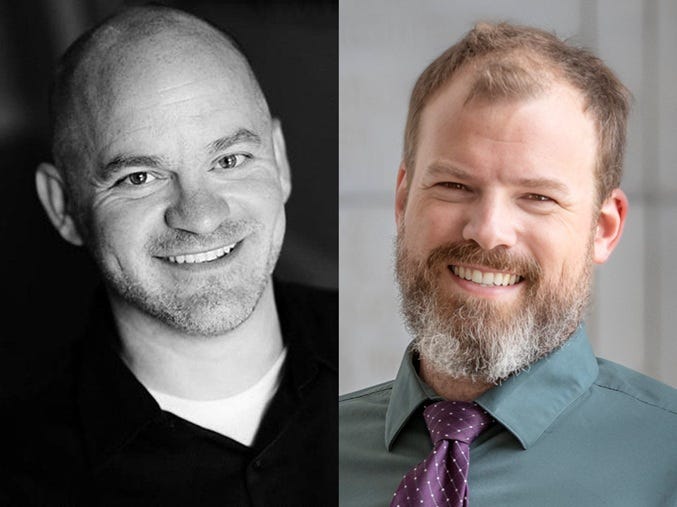
Seth Zeren: Hello and welcome to The New School for City Builders. I’m your host, Seth Zeren, a recovering city planner turned neighborhood developer in Providence, Rhode Island. Joining me today is Aaron Lubeck, an incremental developer and designer in Durham, North Carolina. Aaron has taught historic rehabilitation and sustainable design at Duke University and with the Incremental Development Alliance. He created the podcast for the National Town Builders Association, and he’s probably more responsible than anyone else for pushing me to start this podcast.
In today’s conversation, Aaron will also turn the tables and interview me about the origin of this podcast and the need for a new school for city builders. Aaron, welcome.
Aaron: It’s great to be here. Thanks for doing this, for having me on, and for getting this thing rolling. It’s exciting to see this idea progress through all its iterations.
Seth: It’s so great to have you here. Out of that introduction, I should say I blame you most for this podcast — my wife too, probably. How did you talk me into doing this?
Aaron: In fairness, it’s been a few years. I remember sitting with you in the airport in Cincinnati, both of us getting excited about this idea — the need for a new school, something more than a weekend workshop or a day class. There needs to be a place to send 18-year-olds who really want to build cities, and there just isn’t one yet. Some places get close, but there’s no single place. So many kids want to do this in some form — work on cities, build cities, solve problems — and there’s nowhere to go. There’s so much cool stuff happening, from what’s going on in Florida to the City Makers Collective and beyond, but there clearly needs to be a bigger vision. I think it percolated long enough, and you finally said, “I need to get these ideas out.” And here we are.
Seth: That was sort of two thoughts. One — this is a good advertisement for coming to the Congress for the New Urbanism, because the most important ideas usually come from sitting in an airport at the end of a trip, or taking a long walk after lunch with a friend. That’s where the real ideas percolate. For anyone coming to CNU, I’ll be there in Arkansas in a couple of weeks.
I think part of what drew me to this was a gap. I’m part of these one-off conversations with people about building new institutions, changing how we teach, creating new programs — but there wasn’t a forum bringing those conversations together.
On the other hand, I keep meeting young people — 18, 22, 25 years old — who’ve discovered they’re interested in city building somewhere along the way. We don’t teach any of this in high school, so people stumble into it: watching YouTube videos, reading a book, going on vacation. There’s some inciting incident. I keep meeting people who got radicalized watching Not Just Bikes, then went to architecture school, then realized architecture school wasn’t doing anything like what they expected. So there’s a real need for a forum where young people can learn how to make the most of their education and what to look for in a program.
Aaron: Wholeheartedly agree. And to reiterate — I’m so glad you started this podcast, because it’s narrow and specific. The ones that make a difference are usually on a narrow topic, and there’s nobody in this space. There are plenty of podcasts on urbanism, walkability, design, affordability — but nothing like this. This could evolve into a space people come to when they’re frustrated with the pedagogy — professors, students, families with kids interested in this stuff.
So much has happened since Cincinnati, going on two or three years ago now. Brett Jones’s work in Florida, Nathan Norris’s community college program — which hits some of the gold standard we’ll discuss today — Will McCollum’s summer program in Charleston, which sounds incredible, and Ruben Hanson, who has a great podcast and is getting into teaching in Europe. I see all of these as green shoots.
Before you answer — I know we’re doing a bit of an experiment here. Given my background hosting the Town Builders Podcast for the National Town Builders Association, a good way to plant the flag for this podcast and your website is for me to interview you, so you can lay out your thesis: what’s the point of dissatisfaction, and what do we do about it? So — Seth, why do you think we need a new school for city builders?
Seth: Thanks, Aaron. A lot of this comes from my own experience. Like I said, we all have our breakthrough moment. For me — I’d studied climate science, was a geology major in undergrad, was thinking about grad school and PhDs. I’d also picked up a bug for sustainable design and green building. So I took an early online course — this was around 2006 or 2007 — through the Harvard Extension Program, on the history of the American city. Great course. I read Jane Jacobs for the first time, studied the history of American cities.
Aaron: It’s her birthday today, incidentally.
Seth: It is her birthday today. Happy birthday, Jane Jacobs — or as we like to call it, Urban Renewal Remembrance Day, when we remind ourselves of the dangers of hubris. Go put a wreath on a highway overpass somewhere. Say sorry.
So that course got me excited about city building, but I was intimidated — I didn’t know how to draw, had no portfolio, didn’t think I could go to architecture or planning school. I was a scientist. So I went to a graduate program at Yale where I was technically enrolled in the environmental school but spent half my time secretly taking classes in architecture, law, and business. I got really interested in zoning and land use regulation, and ended up taking a job as a city planner for the City of Newton, Massachusetts — writing zoning amendments, reviewing projects.
While on city staff, I started to see the whole city-builder ecosystem: on the city side, planners, engineers, police and fire, DPW; on the private side, civil engineers, architects, developers. Watching all these pieces interact, I was struck by the fact that we don’t understand each other. We don’t even speak the same language — different jargon, different goals.
Aaron: There’s a stunning lack of curiosity sometimes. The silo-ization keeps it that way — “I don’t understand them, but it’s not my job to.”
Seth: Right. Some people think their job is regulatory compliance — just follow the rules, whatever they are. Some developers just want to make as much money as possible and don’t care about long-term implications. Not everyone’s like that, but I’ll tell a story — we were working on improving a neighborhood village center, trying to improve walkability and pedestrian safety, and we kept hitting a wall with the city engineer. Every time we tried to change something, it was “this doesn’t comply with the regs” or “we don’t have the warrants for a stop sign here.” And we’d say, well, we’re trying to improve safety — what would you suggest? “Nothing, because none of these things meet my book.” And we’re left thinking, what are we all doing here?
Aaron: Right — “the rule book says this.” There’s a reputation in every city for which profession is the most rigid and unbending about doing reasonable things, and engineers often get that label. There’s an understanding of the broader vision, but “that’s not my job, and the rule book says something different.” There are interesting proposals to fix this — calls for some kind of benevolent overseer who could cut through it — but really, it’s the silo issue you write about so eloquently in the piece we’re discussing today.
Seth: Part of the problem is that cities are genuinely complex and do require specialized expertise. I don’t know how to make sure sewers drain correctly — someone needs that skill, and it’s a specialized job. There are a lot of these specialized roles. But look at how we train specialists: architects are in the school of arts and architecture, planners are in the government school, civil engineers are in the engineering college, developers are in the business school, activists are in sociology. Nobody talks to anybody, nobody shares the same goals.
You can get an engineering degree without learning anything about urbanism. You can get an architecture degree without learning anything about development. You can get a development degree knowing nothing about design. These silos start early in people’s technical training, and they persist — you get your first job, and on some paths you pursue licensure, which requires apprenticing at an existing firm or having an accredited degree.
Part of the reason the civil engineering curriculum has nothing about how a city works is that it’s not in the accreditation standards — there’s no room for it. You take four semesters of calculus but zero semesters on the purpose of a city. That’s driven by accreditation, so it’s very hard to change at the ground level. People arrive in specialized jobs with no sense of the whole team. It’s like a football team where everyone does their own thing with no shared playbook, language, or goals. Some specialization is fine and necessary, but without a shared framework, you get chaos — which is exactly what we have. Our cities aren’t functioning in a coordinated fashion.
Aaron: This is getting a bit ahead of the horse, but two of your proposed solutions are a common core curriculum — giving people a shared liberal-arts foundation in what a city is and why it matters — and leadership training. At the end of the day, teamwork requires leadership. On a football team that’s obvious, but I don’t know that city departments are doing leadership development internally. When you’re dealing with problems that take millions of dollars and years to fix, leadership matters — and we’ve all seen how non-functional things get without it. Talk about how the school you’ve envisioned addresses those needs.
Seth: Let’s pull back and talk conceptually — if we were starting over, what would we build, and how? Then we can come back to how you’d actually get there, and why it’s so hard to change existing institutions.
Aaron: Agreed. You’ve established the problem — now, what’s your vision, and why is now the time?
Seth: Let’s set the course. I think there are three big agendas central to building — or reforming — an institution like this.
The first is initial integration of the city-building professions. Engineers, architects, developers, planners, and so on should at least sit in some classes together and work on some projects together. That doesn’t preclude additional specialized training later — but they need a good chunk of time working together, getting to know each other’s personalities, seeing how different skill sets fit together, and developing a shared basis.
One way to think about this: we’ve started specialization too quickly. We need some shared cross-training and shared vision first, then build into specialization. Take civil engineering — I don’t think any civil engineers are using that calculus once they’re in practice. It’s mostly weeding people out for being good at math and following directions.
Aaron: I think that’s right. Architecture has a similar reputation, though there’s less math now that computers do it for you.
Seth: Architecture has a reputation for ridiculous studio projects, harshly reviewed, designed to make you cry and see if you can stomach it. Everyone has their own version of social-control weeding functions. My view is you could do most of the basic specialization training — what amounts to an undergraduate-equivalent period — faster than existing programs do. Part of the reason is that, at the end of the day, all these jobs are really apprenticeships. I need to give you a basic foundation, enough useful skills to be productive in an entry-level job, and get you into the industry to start practicing. You might take more classes later to skill up, but the goal is to get you started.
Aaron: Sure. Is there a strong critique of college pedagogy here — the idea that some of this just can’t be learned in the classroom? There’s an easy counter: maybe we’re just not teaching it in the classroom, so we don’t really know. Architecture is more of an applicable technical skill than, say, a history course — though certainly less so than medicine, where you have to get out and apprentice. But there’s more ability for a freshman architecture student to do construction drawings and elevations than there is in some other fields. Is part of your vision to accelerate that — to start doing, in the classroom, whatever can be done there?
Seth: Yes. The second of the three agendas is a practice orientation — practice has to start at the beginning and continue throughout, increasing in complexity as you go. Not four years of theory before you ever set foot in the shop. I think of Olin College, here in Massachusetts, which was started in the early 2000s — first graduating class around 2005.
Aaron: Oh, that recent? The way you wrote about it, I assumed it was old-guard, Ivy League engineering. I didn’t realize it was that young.
Seth: Right around the turn of the century. Part of their approach was: we’re not waiting four years before students hold a soldering iron. They’re in a workshop the first semester — mechanical and electrical engineering students using tools from day one — to understand the physics and mechanics of what they’re doing and connect with the realities of industry and making things, rather than four years of fundamental science and math followed by, at the end, an applied scientist rather than an engineer in the old sense.
The third piece — and this is maybe a personal feeling — is a shared core curriculum. In most of these programs, nobody sits in the same classroom, nobody studies the same things. You need to bring people together to work on hard stuff. And at the end of the day, a city is a humanistic project. A city without people is a ruin — that’s literally what a ruin is. The city is about people. And we’ve lost that in a lot of technical training — engineers take four years of applied science but never a psychology class; architects never take economics. The behavioral sciences and humanistic arts — why people make decisions, questions of truth, goodness, and beauty — have no home in these curricula.
Aaron: Or sociology, or history.
Seth: Right.
Aaron: Which schools out there currently have a common core? Obviously not architecture programs generally, but —
Seth: There are a few examples, and this is something I hope to dig into more on the podcast — the liberal arts are facing real challenges right now, from multiple directions. AI and the changing nature of student bodies and faculty are affecting the ability to do traditional humanities, and we have to address that, it’s not going away. But at the same time, humans really like learning about other humans. That’s the fundamental purpose — understanding ourselves, understanding others, understanding our relationship to society and where we came from. It’s not about producing better essays faster. The point is for you to understand yourself and others — a large language model can’t do that for you.
There are places still doing this. Columbia has a common core — everyone reads Homer and works up through the moderns in literature, political theory, and philosophy. Yale has a Directed Studies program. And then there’s St. John’s College, a true great-books curriculum — one of my real inspirations, because they’re just going to read classic texts and aren’t self-conscious about not doing what Harvard or Stanford does. It’s strange how few schools differentiate their model by doing something genuinely different, rather than trying to copy Harvard with less money and less prestige.
Aaron: I think that’s totally right. It’s remarkable group-think. I have the same reaction to planning departments — there are thousands of them across the country, and they nearly all have the same parking standards. You’d think somewhere in Wyoming, some city would just try something different. It’s groupthink, and I think the modern world — accelerating data and computing — promised incredible diversity and choice, and in so many ways the opposite happened. In buildings and in education both.
Seth: It’s accelerated sameness, in a sense. Other examples: Deep Springs — another inspiration — a two-year program on a cattle ranch in the American Southwest, after which students transfer to a four-year college. Half your time is spent maintaining the ranch — cooking, fixing fences — and half reading and working together as a group. And Olin again — “we’re just going to do it differently and not play the same game.”
Aaron: To put a pin in that — the best carpenter I ever worked with was a Deep Springs graduate. He went on to study divinity at Oxford, then ended up working in crawl spaces for me before we realized the guy was a brilliant carpenter and moved him into millwork.
Seth: A carpenter with a divinity degree seems like a fitting path.
Aaron: It is. We’re publishing a piece today at Southern Urbanism by Nick Larkins — a carpenter-philosopher, which is sort of the model of person these programs should be producing.
Seth: If you’re in professional practice, public or private, working in a complex city dealing with history and an economy and other people, you need a broad toolbox for thinking, communicating, and understanding — because it’s not a purely technical problem. Getting things done in a city is relational. It’s about working with people and managing yourself. The best training for that might genuinely be literature, philosophy, and theology — because we have thousands of years of writing about living together in large groups without killing each other. That’s half of all philosophy, from the Greek polis to the present: how do you live together and get things done without it going sideways?
Aaron: And the benefits aren’t hard to articulate. Mike Rowe has written about this — functionally, we’re producing an intellectual overclass with liberal arts degrees who can’t plunge a toilet or caulk a window. We need people who can read philosophy and fix things, and plumbers who understand context and the humanities. Right now there’s a hard wall between those two worlds.
Seth: A hard barrier, but not a permanent one. There have been plenty of times historically when working-class people were reading and engaging with ideas. We need to get back to some of that — it’s another version of breaking down the silo.
Aaron: And it goes both ways. Many of the problems we see in practice come from the other direction too — the planner or government official who has no idea how the trades or construction actually work. In some ways that need is even more acute than the plumber-reads-philosophy direction.
Seth: True. As I’ve worked through these ideas, I keep coming back to an undergraduate-equivalent program that gives people a strong foundation — knowledge, perspective, and skills — so they can go apprentice and work. For some, that might be all the formal education they ever get. Others might layer something on top — an engineering degree to become a PE, a PhD to teach. But everyone gets that thick foundation that lets them keep reading, learning, and practicing on their own.
If I had to name the ideal career outcome — the highest aspiration for our graduates — on the private side, it’s the real estate developer, because a good developer shapes and orchestrates the private realm, hires good consultants, builds a good team, and you get amazing work. A bad developer who doesn’t care can do real damage.
On the public side, it’s the city or town manager — the deputy mayor, the executive-branch roles that actually operate the city and direct the other departments. One problem with how we’ve stylized professional training is that most ambitious young people who want to fix cities from the public side end up in the planning department — and get stuck there. That was my experience; I was a planner and switched to the private sector because I wanted agency and effectiveness. The planning department doesn’t have shovels, trucks, guns, or much discretionary money. Its power is persuasion — and to a lesser extent, writing ordinances, though even then the law department often has the final say. So if you’re a planner, especially a junior one, your core skills need to be politics and persuasion — but you’re not empowered to use them. You’re not going to have coffee with city councilors and whip votes for your ordinance; that would be deeply inappropriate. Maybe the planning director can do some of that. But ultimately it’s the mayor and elected officials who decide. I wrote a bunch of zoning ordinances, but I didn’t get a vote.
So a lot of planners get stuck in that department. The ambitious, rebellious ones leave. The ones who learn to work within the bureaucracy’s constraints stay — but they’re not rotating through DPW, finance, the assessor’s office. The energetic young people interested in public service end up concentrated in maybe one-fifteenth of city government and are essentially invisible to the rest. What I really want is for them to get into that executive office where they can direct resources and priorities across departments. And to do that, planning education — which is maybe 5-10% focused on persuasion and politics, the actual core skill — doesn’t equip them.
Aaron: Really interesting — we bantered about how this school could look and had slightly different visions, which will be fun to reconcile. It’s interesting that you want to train public-service professionals too, where the need is clearly there. You could even argue for fewer planners but higher-level ones — town planning directors and managers with something like five years of intensive training across law, design, architecture, politics, and leadership.
The critique, though: starting a school is an enormous lift — this is “pulling the sword from the stone.” It’s the same critique we ran into at the Incremental Development Alliance, which succeeded because it focused narrowly on training small-scale developers and did that one thing well. Eric Kronberg always took your approach — you can train all the developers you want, but if they’re walking into the buzzsaw of American zoning and politics, which punishes small developers at every turn, you’re sending them on kamikaze missions. So we have to deal with the cities too. Given that, are training city builders and training public servants actually the same training? Compatible? Does combining them dilute the core mission — or do you genuinely see public servants as city builders too?
Seth: Absolutely, public servants are city builders — and one problem is we don’t treat them that way in practice. Because planners aren’t competitive for that upper tier, city and town managers are usually drawn from the law department or the finance department — people seen as understanding the rules and the money. But finance and law are fundamentally compliance orientations, not entrepreneurial ones.
Aaron: It’s a glass ceiling.
Seth: Right — and it’s risk-averse. The CFO’s job is to make sure the budget balances and the rainy-day fund is full; that’s a defensive posture. The law department is trying to avoid getting sued. Part of why the public sector is bad at city-building is that we don’t have city builders in those positions.
I wrote an essay on this — we’ll link it in the show notes — and got a lot of positive response, plus some pushback, including from Chuck at Strong Towns. His argument was that it’s more about restructuring how things work, and that the people are already there, just not empowered correctly. I hear that, but I don’t think we currently have the right people for those jobs. We do need to restructure city government to allow more risk-taking, more small bets, more iteration — good Strong Towns principles. But I’m not convinced we have anywhere near enough people prepared to work in city government and be entrepreneurial risk-takers.
Aaron: I agree. I was hoping to reread that piece before this conversation — I remember it being a great exchange, and I generally agreed with your take. We all love Chuck — he’s probably been the most successful media voice in New Urbanism for a while, and his basic thesis on sprawl being unsustainable is essentially unimpeachable. But he’s not on the front lines of permit applications the way you and I are, and hasn’t been for years. So on what the front-line experience is actually like, I think he can just be wrong.
I see a handful of people in those planning and zoning roles trying to fight the good fight every year — and they’re always the most exhausted people at CNU. “I’m so stuck, I’m trying to do the right thing.” When you look at how many planners and public officials there are nationally — tens of thousands — the fact that there’s only a handful really validates your point. There’s no bench anywhere in the USA you could point to and say, “these people know how to fix the streets, get the parks right, run the utilities, work with developers, and pursue a vision.” We’re not training that in any professional school — not just planning, but architecture, development, and engineering too.
Seth: Right. My own program was a nominally professional environmental management degree. When they surveyed alumni about which skills mattered most — for people going on to work for the EPA, manage forests, or run sustainability offices — the answers were communication, financial management, project management. When they surveyed faculty, the priorities were the opposite: statistical analysis, scientific research. Which makes sense — the faculty were career ecologists doing interesting forest-ecology research, but they’d never worked in industry, government, or an NGO. They were completely disconnected from the practice of, say, actually improving how the U.S. manages forest land. It might help if you’d worked for a logging company or a state forestry department at some point — some connection to how an agency or company actually runs.
Aaron: And there’s resistance to that. I taught for four years at Duke’s Nicholas School of the Environment — also elite, also environmental management — and had the exact same experience. I was in a room where they tried to design an environmental entrepreneurship program, similarly out of left field for them. I have no idea what became of it, but the faculty’s conclusion was essentially, “this isn’t what we do” — nobody on the faculty spoke entrepreneurship; they were all researchers. It’s oil and water, and that’s a real challenge for doing something like this at any legacy institution. Which gets to my next question: why might — or might not — this work within existing universities?
Seth: Good question, and I get asked it constantly. Starting a new school from scratch is incredibly hard — it just doesn’t happen much. Very few new schools have been founded in the U.S. in the last fifty years. So much else has changed, but the list of colleges and universities looks largely the same. A few major reasons it’s so hard to change existing institutions:
You mentioned one — these institutions are organized around a research-first model. Faculty are hired and promoted based on research output, going back to the PhD itself, and that’s not inherently bad. But when that research is disconnected from professional practice — and I’ve felt for a long time that very little coming out of academia in the city-making fields is interesting or useful — most of the real intellectual work comes from practitioners. People like Chuck, who are out there digging in the weeds. CNU is a very intellectual, creative, conceptual space, but almost everyone there is also a practicing professional with clients and billable hours, trying to get things done.
So one big challenge is staffing — you can’t staff a school like this entirely with career-research PhDs; they don’t have the right skills. We need people with practice experience who are also interested in ideas and in teaching well — and those two things don’t always coincide. Great practitioners aren’t always great teachers. To some extent we’ll have to build our own teaching corps — people who come up through our programs, learn the practice and the ideas, and want to come back and teach the next generation. That requires building almost a parallel track to prepare them.
Aaron: I was going to say — when we get to my vision for the school, I don’t actually think finding talent to teach would be that hard, based on my experience with IncDev and others at CNU. Within our bubble there’s an incredible wealth of talent; outside it, less so, but it’s out there. The bigger headwind, once you step outside the research-based model that fuels these universities, is accreditation. I know you’re planning to address this in an early episode, but is that a real headwind to what you’re trying to do?
Seth: It is. To be clear, we’re not building a four-year college next year — that’s the culmination of a lot of effort. In the meantime: the Incremental Development Alliance is teaching great programming and will keep expanding it. Will McCollum’s City Makers Collective is running fantastic summer studios. There’s online professional education, what Ruben Hanson is doing with The Aesthetic City. We can run weekend courses, summer schools, study-away semesters for college students — a lot of things that don’t require building the full infrastructure of a college and don’t require accreditation. That’s where we start — and where people have already started.
Part of the point of this podcast is to bring together the people running and creating these programs, to talk about what they’re doing, share what’s working pedagogically, inspire new programs, identify gaps, and replicate successes in new cities. That builds a critical mass, develops skills and expertise, and forms the foundation that eventually makes a physical school easier to build. And ultimately, I don’t think it’s just one school — I don’t want any of these schools to get gigantic. They should be smaller, more nimble, more innovative, more high-touch. The school doesn’t need to be its own city with all the overhead and administration that implies — keep it lean. That’s the only way to survive the current cost environment in higher education.
What would be great is regional iterations with shared DNA: a City Building Institute of New England would differ from one in the Southeast, the Midwest, or Portland — and that’s good, as long as there’s enough shared foundation to collaborate, share case studies, and avoid each one recreating the core curriculum from scratch. Because it’s a network, you could spend a semester or a year at a different campus — study abroad in Portland, if you’re based in the Southeast.
Aaron: I love that. It’s a logistical puzzle, but conceptually — a two-year core program, partly online or centrally taught, with several semesters “on the road”: sustainability in Portland, greenfield development in the South, traditional building arts and history in Charleston or New England. That could be amazing, even partnered with existing organizations like the American College of the Building Arts.
Seth: We don’t have it all figured out, but part of what’s exciting is approaching this entrepreneurially and with an institution-building mindset — recognizing we need institutions that outlive individuals. What tends to happen is a great dean or a few great faculty make a program excellent for a while, but eventually they retire or leave, new people come in, and it reverts to the mean. That happened with Miami’s architecture program — one of the New Urbanist stars alongside Notre Dame — after Elizabeth Plater-Zyberk stepped down as dean; it reverted toward every other program, because there was no longer a person or group demanding it be different. Institutions have so much inertia, and so much “keeping up with the Joneses,” that you almost have to be willing to say, “we’re not doing what everyone else is doing.” Interestingly, a lot of the most interesting things happening in higher education right now come from religious institutions — I think because they’re willing to say, “we’re a Catholic school, we’re going to teach differently, and we don’t have to pretend to be Harvard.”
Aaron: It is bizarre how Catholic schools have become the rebels here, especially in architecture. I was trying to map Notre Dame’s “coaching tree” — its influence on other programs — at NTBA. Utah Valley’s young program is Notre Dame-trained; Benedictine College in Kansas is Notre Dame-oriented; Andrews University, which I’d assumed was just because of proximity to Notre Dame, also fits. And ACBA has Notre Dame talent too. Public institutions seem far less likely to innovate and more likely to conform — though I don’t know if that holds everywhere.
Seth: Part of it might be an orientation toward accreditation. My hope is that eventually our own network could self-accredit — create our own accrediting body.
Aaron: Are you tracking — given the current disdain for academia and intellectual life in the current administration, there’s apparently movement toward a third accrediting body that some red-state universities are considering for various reasons. Has any of that affected your thinking?
Seth: There’s a lot happening that’s hard to parse, but I’m cautiously hopeful that there’s appetite to shake up accreditation. Ostensibly, accreditation exists to protect consumers — families and students — from being fleeced, given how imperfect the information is. It’s also tied to financial aid eligibility, both governmental and institutional, and in many professions it’s an easier path to licensure if you attend an accredited program. So there are reasons it exists — but it also creates a weird centralizing effect that discourages creativity, entrepreneurship, and experimentation. It’s incredibly conformity-oriented, and I have a modest hope that will loosen, both in regulatory practice and in the popular imagination — that people will become less anxious about accreditation, or more open to different kinds of it.
Aaron: Walk through the logistics. It’s frustrating — college towns should be centers of innovation, places where you can afford to be wrong, experiment with ideas and designs. In our lifetimes, the opposite has often happened — regulation and constraints on speech and architecture and everything else. Ideally you’d run a two-, three-, or four-year program that’s just genuinely great education, producing 21- or 22-year-olds who are ready to do great work in our world. If you had the content but not the accreditation — no PhD-heavy research faculty — what specific challenge does that create for getting a school off the ground?
Seth: A few components. One is laddering up through things that don’t require accreditation: weekend intensives, summer schools, semester-abroad programs, maybe an affiliation with another institution — “come to our city, do a full semester our way, and you’ll learn a lot of useful things.”
We can also build other professional certifications — IncDev has talked about online courses. I’ve increasingly been thinking about a one-year executive education certificate, particularly for people who might move into leadership roles in their firm or in city government. If you’ve been a practicing architect or planner for ten or fifteen years, you may have hit the ceiling of what your core skills alone can do — a graduate-level certificate could ladder you up.
We’ve talked to New Urbanist-oriented firms that hire new grads and, unless they’re from Notre Dame, basically have to re-educate them for the first couple of years. If we could bring those grads in for a six-week boot camp, it would be hugely valuable to those firms — people coming in at a much higher level, able to engage immediately.
Put all that together — a full summer calendar, two semester calendars, a one-year online certificate program — and you’ve basically got the guts of a school. Classroom space, residential space, used at different points in the year. At some point, building out a physical school requires real capital — family foundations, real estate developers in their legacy-building years. One of my inspirations: a local university here in Rhode Island got a $20 million gift to add a real estate program to their architecture school. I taught there for a semester and got familiar with the program, and honestly thought, if this is the competition, we could really outdo them. So — where’s my $20 million gift? Half-joking, but it is possible to raise that kind of money and use it to build out a lean physical plant — keeping overhead much lower than existing institutions carry.
Then accreditation is the tricky bridge to cross. Without it, you give up a lot of financial aid eligibility, which you’d hope to offset by being cheaper — leaning up the program.
Aaron: Or by finding aid elsewhere — a philanthropist covering it. Is the American College of the Building Arts accredited, do you know?
Seth: I believe they are now, or have been working toward it — which gives some credibility and a path to navigate. I think this is an area we’ll have to work on continuously, paying close attention to reform efforts. Accreditation is ostensibly for consumer protection, but in practice nobody really understands it — it functions as an insider club, a guild protecting these schools from competition. If we could create new kinds of accreditation-like signals that are genuinely consumer-facing — “if you come here, you’ll get a job,” “your classes won’t be ridiculous” — that would help.
Aaron: We talked about this in Cincinnati too — probably a terrible strategy, but you could brand the school as emphatically not accredited, given all the shenanigans around accreditation. “If you want to actually learn this stuff and become elite at city building, come here. If you want a credentialed institution teaching theory, there are plenty of those.”
Seth: I think there’s room for that. We don’t need 100,000 students. Two thousand students would be a tremendous transformation — 500 a year. Even starting with 40 a year would be something.
Aaron: There are cracks in the accreditation system worth noting. I just learned Utah Valley University — which has a phenomenal traditional program producing talented students — isn’t actually accredited for their five-year architecture program; they’re going through the process now. So even programs with relatively traditional offerings have to fight for it.
Seth: Right — you have to. That’ll be an important part of this ongoing conversation, but I’m intrigued by the scenario where we just don’t play by the same rules.
Aaron: I think that could be genuinely attractive to certain people. Planning tends to attract more risk-averse personalities — less likely to sign a personal guarantee or put themselves at risk. But there are 18-year-olds out there who want the fight — who get energized by the hunt, by the challenge. Jane Jacobs talked about “guardian” versus “commerce” culture — fundamentally different temperaments. Right now there’s no real path into that commerce-culture, entrepreneurial side. Even undergraduate business programs — which used to be graduate-only — mostly train people for corporate work. There are nominally entrepreneurial classes, but they’re really corporate-flavored. There are kids who want to fight for this stuff day to day, and there’s just a void of opportunity for them.
Seth: A lot of young people get energized by activism partly because it feels like they’re really working on something, pushing against the system. We can offer the same energy through a different channel — real tools, real power, real ability to affect things. And it’s not hard to imagine a career pipeline — we have a big network of people who’d hire into this work.
Aaron: Or who’d create jobs. When I was working on the entrepreneurship program at Duke, we used to joke: universities track the percentage of graduates employed six months or a year out — what they should track is the percentage who are employers a year out. Even one or two percent would be remarkable — someone starting a business right out of your program. That distinctiveness might be exactly the appeal — like Deep Springs, where people look at it and think, “that’s different, that’s interesting.”
Seth: Really different. Part of my belief is that even though higher education is going through a lot of tumult right now — colleges closing, for various reasons — that instability creates an opportunity. People will respond to things done differently. Taking a harder swing, doing something a little wacky, might actually be a better strategy than trying to look glossy and keep up with everyone else.
For example — I’ve had this idea for young people who feel like their brains have been rotted by screens and AI: a program where, for the first year, you’re in the woods with a typewriter and some books, working only on paper. You type your term papers. There’s a single phone at the end of the hall if you need to call home. No cell phones — a full societal detox in the woods of Vermont. People would love that. I don’t need everyone to love it — I need a few hundred people to love it, and that’s enough to run these institutions, especially with a different approach to financing and structure.
Aaron: So you’re going to need a college football team to finance, basically.
Seth: Or something like it — we’ll need our own big rituals and inspirational traditions.
Aaron: We’re at about an hour, so let me close with two questions — one narrow, one big picture. You’ve described wanting to build this incrementally, and as an incremental developer myself, I subscribe to that completely. Starting with weekend classes, online programs, partnerships, summer trips — that all sounds smart and achievable. But do you also have a parallel “full plan” — if someone showed up wanting to fund the whole vision at once? The comparable here is the University of Austin, which I believe raised something like $250 million to start a new college, now in its second year, focused on the classics with not much practical/apprenticeship component. They raised nine figures to start a school. Do you see that as a path — and if someone wanted to write that check, would it actually accelerate things, or are you committed to the incremental approach regardless?
Seth: Yes — I’ve worked on several models over the years for two-, three-, and four-year programs in different contexts: urban versions, rural versions, financial models for building it out over time. So if someone wants to write a check with a lot of zeros, we could move quickly.
That said, I think incrementalism remains important even with a large check. Even UATX did a lot of iteration — summer programs and so on — to build the story; you’d do that regardless. And even building a physical school, we’d still run these other programs in parallel: the one-year graduate certificate, summer schools for high schoolers like a “Career Discovery” model, “semester in the city” programs. You could have a very full set of offerings quickly, rather than starting with just a freshman class and building up year by year over decades. I think there’d be tremendous interest, and we could recruit excellent faculty and staff quickly to launch something like this. So — if you know someone who’d like to write a check north of $10 million, please reach out after the show.
Aaron: Leave your Venmo in the show notes.
Seth: Venmo in the show notes.
Aaron: I’ll close with this. We’ve covered your dissatisfaction with current pedagogy and how cities get built, and your vision for filling that void. This is clearly a long game — not a quick policy fix, but a culture change, which is slow. Take a breath, and then — if you’re Picasso painting this vision — describe a total home-run success, five or ten years out. What does a thriving city-builder institution look like, both as a university and for the industry?
Seth: That’s a good question. I’m an incremental developer by day, and I live in a house built in 1890 — a big part of what we do is build things that outlast us, and act as stewards of places and institutions. This is a long game. I don’t expect to finish it in my lifetime. It’s taken roughly a hundred years to get how we build cities to where it is now; it’ll probably take close to that long to find our way back out. We’re making progress, but it’s a process.
The only way to do that is to build new institutions with new cultures — durable, not swayed by the wind, oriented toward a larger purpose. If I’m looking back from 2050, in our glorious imagined future, like Edward Bellamy looking backward: I’d picture an ecosystem of programs — short courses, graduate certificates, undergraduate programs — and a network of city- and town-builder colleges across the country, maybe six or eight in different regions, collaborating the way we’ve discussed. Plus satellite campuses internationally — Europe, Latin America, East Asia, Africa — so students can spend six months or a year, like Notre Dame students do, living in a different kind of urbanism and gaining perspective and confidence.
These institutions would be training thousands of new professionals a year. And because we’d be excellent, existing institutions would start copying our methods. We’d be ecumenical about it — running summer programs for faculty from other schools, teaching them how we do it — and we’d pull those programs along simply by attracting their best students and, eventually, their best faculty. That’s the only way I see Harvard’s GSD, MIT’s planning program, or UNC’s planning school getting dragged toward a different model.
By 2050, there’d be tens of thousands of our alumni doing important work — mayors, city managers, developers, running cities and towns, leading their professions, helping reform architecture and civil engineering around a shared enterprise: building places people love. Instead of disposable places and disposable people, we’d be building and running towns meant to last a thousand years — sustainable, yes, but also financially viable, resilient, prosperous, and genuinely loved. Because if people don’t love a place — or an institution, or a school — they won’t maintain it, no matter how good it looks on paper. People need a deep, abiding affection for a place to take care of it.
Aaron: So what I’m hearing is you’ll eventually need to finance a college football team too.
Seth: Something like that — we’ll need our big rituals and inspirational traditions.
Aaron: Not to discount anything you just said — I think it’s a great vision, and I wholeheartedly subscribe to it. Next time, you get to interview me on how my vision differs slightly, and we’ll see what it’s worth.
Seth: I look forward to it — let’s do that soon. Thanks, Aaron.
This is The New School for City Builders, a production of the Educational Collaborative for Building Places People Love, and Build the Next Right Thing. If you appreciate what we’re doing and want to help bring this school to fruition, please support us by becoming a paid subscriber at buildthenextrightthing.substack.com. And if you happen to have the ability to write a very large check — please reach out.

